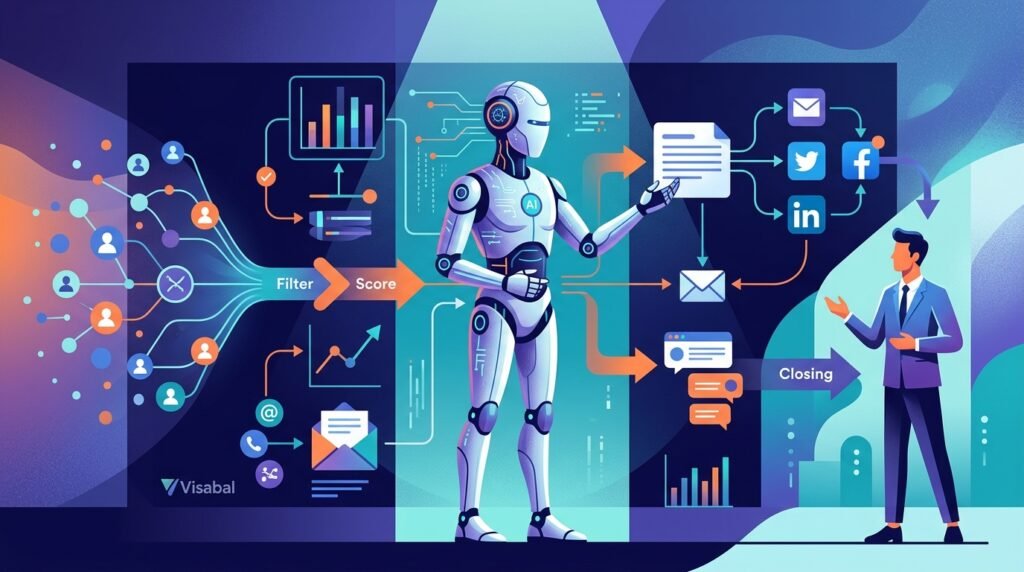
Sales development has always been a game of timing, relevance, and consistency. The problem is that most SDR teams spend too much of their day on repetitive tasks: researching accounts, finding contacts, writing first-touch emails, logging activity, following up, and deciding who to prioritize next. AI SDRs are designed to reduce that manual workload while helping teams engage prospects faster and more intelligently.
So, how do AI SDRs work? In simple terms, an AI SDR uses artificial intelligence, automation, data enrichment, and workflow logic to identify prospects, personalize outreach, manage follow-ups, qualify interest, and route opportunities to the right human seller. The best systems do not replace sales strategy. They execute structured outbound and inbound sales development processes at scale while giving human reps more time to focus on conversations that matter.
At Visabal, we view AI SDRs as execution engines for modern go-to-market teams: they combine data, messaging, timing, and automation to create a more efficient prospecting motion.
What is an AI SDR?
An AI SDR is software that performs many of the tasks traditionally handled by a sales development representative. This can include prospect research, lead scoring, message generation, email sequencing, follow-up reminders, meeting qualification, CRM updates, and handoff to account executives.
Unlike basic sales automation tools, AI SDRs can interpret data, adapt messaging, summarize interactions, and make recommendations based on prospect behavior. For example, if a prospect opens three emails, visits a pricing page, and replies with a question about implementation, an AI SDR can identify that buying signal, update the CRM, and alert a human sales rep.
The goal is not just to send more messages. The goal is to create more relevant conversations with the right people at the right time.
How AI SDRs Work Step by Step
1. They define the ideal customer profile
An AI SDR needs direction before it can perform well. That direction usually starts with your ideal customer profile, or ICP. This includes information such as:
- Target industries
- Company size
- Geography
- Revenue range
- Technologies used
- Buyer roles and titles
- Common pain points
- Buying triggers
For example, a B2B SaaS company might target operations leaders at mid-market logistics companies using outdated manual reporting tools. Once the ICP is defined, the AI SDR can use that framework to find and prioritize relevant accounts.
2. They collect and enrich prospect data
AI SDRs work by pulling information from multiple sources, including CRM records, website activity, third-party databases, LinkedIn-style company profiles, intent data, email engagement, and form submissions. The system may enrich records with missing details such as job title, company size, industry, or technology stack.
This data layer is critical. Better input leads to better outreach. If the AI SDR knows a prospect recently hired a VP of Sales, raised funding, opened a new location, or downloaded a relevant resource, it can use that context to create a more specific message.
3. They score and prioritize leads
Not every lead deserves the same amount of attention. AI SDRs can assign scores based on fit and engagement. Fit scoring looks at whether the prospect matches your ICP. Engagement scoring looks at what the prospect has done.
Common scoring signals include:
- Job title matches a target persona
- Company fits the desired industry or size
- Prospect visited high-intent pages
- Prospect opened or clicked emails
- Prospect replied positively
- Account shows buying intent
- Existing CRM history suggests opportunity potential
This helps sales teams focus on the best opportunities instead of treating every contact equally.
4. They generate personalized outreach
One of the most valuable parts of an AI SDR is message creation. Instead of relying only on static templates, AI can draft emails, LinkedIn messages, call notes, and follow-ups based on prospect-specific details.
A good AI SDR might reference a prospect’s role, company initiative, industry challenge, or recent activity. For example, instead of saying, “I’d love to show you our platform,” it might say, “I noticed your team is expanding into new regional markets, which often makes pipeline visibility and territory coverage harder to manage.”
That kind of context makes outreach feel more relevant and less automated.
5. They run multi-step sequences
AI SDRs can manage outreach across multiple steps and channels. A typical sequence might include:
- Personalized introduction email
- Follow-up email two days later
- LinkedIn connection request
- Value-driven follow-up with a case-specific insight
- Final breakup email
- Re-engagement later if behavior changes
The AI SDR tracks which step each prospect is in, pauses outreach when someone replies, adjusts timing based on engagement, and prevents duplicate or conflicting communication.
6. They interpret replies and classify intent
Modern AI SDRs can analyze prospect replies and determine what they likely mean. A response such as “circle back next quarter” can be marked as a future follow-up. “Send me pricing” can be flagged as high intent. “Not interested” can be marked as a disqualification.
Common reply categories include:
- Interested
- Not interested
- Referral to another contact
- Objection
- Request for more information
- Timing issue
- Out of office
- Unsubscribe
This classification helps keep the sales process organized and ensures that interested prospects are not missed.
7. They book meetings or route qualified leads
When a prospect shows buying intent, the AI SDR can take the next step. Depending on the setup, it may offer calendar times, ask qualification questions, send a booking link, notify a human rep, or create a task in the CRM.
For inbound leads, this speed matters even more. If someone requests a demo or fills out a contact form, an AI SDR can respond instantly, qualify the lead, and route it to the right person based on territory, company size, or product interest.
8. They update the CRM automatically
CRM hygiene is one of the biggest pain points in sales. AI SDRs help by logging emails, updating lead status, recording reply summaries, adding notes, and creating next steps. This gives managers cleaner pipeline visibility and reduces administrative work for reps.
Accurate CRM data also improves future AI performance because the system can learn from outcomes such as meetings booked, opportunities created, and deals won.
What Tasks Can AI SDRs Automate?
AI SDRs are especially useful for repetitive, rules-based, and data-heavy work. They can help with:
- Prospect list building
- Lead enrichment
- Account research
- Lead scoring
- Email personalization
- Sequence management
- Follow-up scheduling
- Reply classification
- Meeting handoff
- CRM logging
- Re-engagement campaigns
- Inbound lead response
This does not mean every task should be fully automated. The best results usually come from combining AI execution with human oversight.
Where Humans Still Matter
AI SDRs are powerful, but they are not a complete replacement for human sales judgment. Humans are still essential for strategy, complex discovery, relationship building, negotiation, account planning, and nuanced conversations.
A human seller can read between the lines, understand internal politics, adapt to emotional cues, and build trust in ways AI cannot fully replicate. AI SDRs should support humans by handling the repetitive work that slows them down.
In a strong sales development motion, AI handles speed and consistency while humans handle judgment and relationships.
Benefits of AI SDRs
When implemented properly, AI SDRs can create meaningful improvements across the sales funnel.
Faster response times
Inbound leads can be contacted immediately, even outside normal business hours. This matters because response speed has a direct impact on conversion rates.
More consistent follow-up
Many deals are lost because follow-up is inconsistent. AI SDRs do not forget, get busy, or skip steps. They keep sequences moving.
Better personalization at scale
AI can tailor messages using prospect and account data, making outreach more relevant without requiring reps to manually research every contact.
Cleaner CRM data
Automatic logging and updates reduce manual admin work and improve reporting accuracy.
Higher rep productivity
Human SDRs and account executives can spend more time on live conversations, qualified meetings, and strategic account work.
Common Mistakes to Avoid
AI SDRs work best when they are implemented thoughtfully. Common mistakes include:
- Sending too many generic messages
- Using poor-quality prospect data
- Automating without clear qualification rules
- Failing to monitor tone and accuracy
- Not integrating with the CRM
- Measuring only activity instead of pipeline impact
The goal is not to maximize the number of emails sent. The goal is to maximize relevant conversations and qualified opportunities.
How to Measure AI SDR Performance
To understand whether an AI SDR is working, track metrics that connect activity to revenue outcomes. Useful metrics include:
- Lead response time
- Email reply rate
- Positive reply rate
- Meeting booking rate
- Show rate
- Qualified opportunity rate
- Conversion from lead to opportunity
- Pipeline generated
- Cost per qualified meeting
- CRM completion rate
Activity metrics matter, but they should not be the only focus. A campaign that sends fewer messages but creates better meetings is usually more valuable than one that generates high volume with poor fit.
Final Takeaway
AI SDRs work by combining data, automation, personalization, and workflow intelligence to perform sales development tasks at scale. They identify the right prospects, prioritize leads, create relevant outreach, manage follow-ups, interpret replies, update the CRM, and route qualified opportunities to human sellers.
For modern sales teams, the advantage is clear: AI SDRs can make prospecting faster, more consistent, and more data-driven. But the strongest results come when AI is paired with a clear strategy, strong messaging, accurate data, and human sales expertise.
Visabal helps teams think about AI SDRs not as a shortcut, but as a smarter operating system for sales development. When built correctly, an AI SDR becomes more than an automation tool. It becomes a reliable engine for turning market signals into meaningful sales conversations.
Frequently asked questions
How do AI SDRs work?
AI SDRs work by using artificial intelligence, automation, and prospect data to identify leads, personalize outreach, manage follow-ups, classify replies, update the CRM, and route qualified opportunities to human sales reps.
Do AI SDRs replace human SDRs?
AI SDRs can automate many repetitive sales development tasks, but they do not fully replace human SDRs. Humans are still needed for strategy, relationship building, complex discovery, negotiation, and judgment-heavy sales conversations.
What can an AI SDR automate?
An AI SDR can automate prospect research, lead enrichment, scoring, email personalization, outbound sequences, follow-up scheduling, reply classification, meeting routing, and CRM updates.
Are AI SDRs good for inbound leads?
Yes. AI SDRs are especially useful for inbound leads because they can respond instantly, qualify interest, ask routing questions, send scheduling links, and notify the right sales rep without delay.
What makes an AI SDR successful?
An AI SDR is most successful when it has accurate data, a clear ideal customer profile, strong messaging, CRM integration, defined qualification rules, and ongoing human oversight.