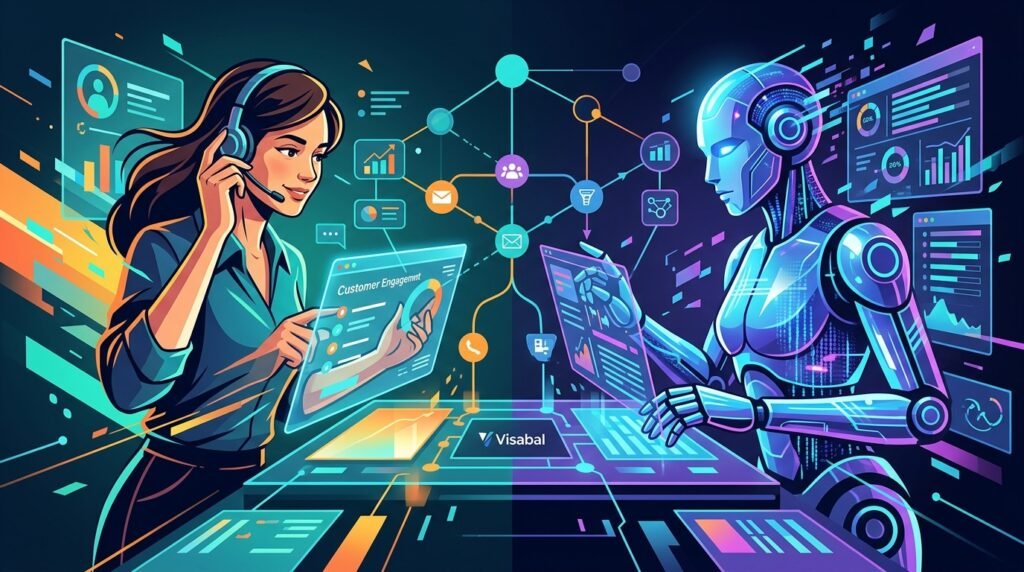
The question of AI SDR vs human SDR is no longer theoretical. Sales teams are under pressure to create more pipeline, respond faster, personalize outreach at scale, and keep acquisition costs under control. At the same time, buyers are harder to reach, inboxes are crowded, and generic outbound gets ignored.
That is why more revenue leaders are asking whether an AI SDR can replace, support, or outperform a traditional human sales development representative. The honest answer is that both have strengths, both have limits, and the best results often come from designing a system where AI and humans each do what they do best.
This guide breaks down the differences between AI SDRs and human SDRs, where each one wins, where each one struggles, and how teams can build a high-performing outbound motion with the right mix of automation and human judgment.
What is an AI SDR?
An AI SDR is software that uses artificial intelligence to perform sales development tasks such as prospect research, lead prioritization, email writing, follow-up sequencing, enrichment, CRM updates, and sometimes meeting qualification. Instead of manually building lists and writing every message from scratch, an AI SDR can process data, generate outreach, trigger workflows, and help manage large volumes of prospects.
A strong AI SDR workflow can support tasks like:
- Identifying target accounts that match an ideal customer profile
- Finding relevant contacts within those accounts
- Researching signals such as funding, hiring, technology usage, or role changes
- Drafting personalized email and LinkedIn message copy
- Running follow-up sequences based on prospect behavior
- Categorizing replies and routing interested leads
- Updating CRM fields and activity records
- Surfacing accounts that deserve human attention
The key advantage is scale. An AI SDR can analyze and act on far more data than a person can in the same amount of time.
What is a human SDR?
A human SDR is a sales professional responsible for prospecting, qualifying leads, starting conversations, and booking meetings for account executives or closers. Human SDRs bring judgment, empathy, creativity, objection handling, and relationship-building skills to the sales process.
A strong human SDR can:
- Understand nuance in buyer conversations
- Adapt messaging based on context and emotion
- Navigate complex buying committees
- Build trust through thoughtful communication
- Ask follow-up questions that reveal pain and urgency
- Handle objections in real time
- Coordinate with account executives on strategic accounts
- Learn from conversations and improve messaging over time
The key advantage is human judgment. A person can interpret tone, adapt to ambiguity, and build relationships in ways AI still cannot fully replicate.
AI SDR vs human SDR: the biggest differences
1. Speed and volume
AI SDRs win on speed. They can research accounts, generate drafts, enrich records, and run follow-ups across hundreds or thousands of contacts far faster than a human team. If your bottleneck is data processing, list building, or repetitive outreach administration, AI can create immediate leverage.
Human SDRs are slower because they work one task at a time. However, slower does not always mean worse. For high-value accounts, a carefully researched and well-timed human message can outperform large volumes of automated outreach.
Best fit: Use AI for speed, coverage, and first-pass research. Use humans for priority accounts and conversations that require judgment.
2. Personalization quality
AI SDRs can personalize at scale by pulling details from company websites, LinkedIn profiles, job posts, news, funding announcements, and CRM data. This makes it possible to create outreach that feels more relevant than a generic template.
However, AI personalization can become shallow if it only references surface-level facts. For example, mentioning a prospect’s job title or recent company post is not the same as understanding their business challenge.
Human SDRs can create deeper personalization when they understand the account, the prospect’s role, and the likely pain points. They can connect dots across multiple signals and write with more emotional intelligence.
Best fit: Use AI to gather context and draft options. Use humans to refine messaging for strategic prospects.
3. Cost and scalability
Hiring, training, managing, and retaining SDRs is expensive. Salaries, commissions, software seats, onboarding time, and management overhead all add up. When a team needs more coverage, the traditional answer has been to hire more reps.
AI SDRs change that equation by letting teams scale prospecting capacity without adding headcount at the same rate. One revenue team can use AI to increase output, improve data hygiene, and reduce manual work.
That said, AI is not free. It requires software investment, implementation, governance, prompt tuning, workflow design, and ongoing optimization. Poorly configured AI can create noise, damage deliverability, or generate low-quality meetings.
Best fit: Use AI to improve efficiency and reduce repetitive work, but budget for setup, strategy, and oversight.
4. Consistency and process discipline
AI SDRs are highly consistent. They do not forget follow-ups, skip CRM updates, or become distracted by competing priorities. Once a workflow is defined, AI can execute it repeatedly.
Human SDRs vary in performance. Some are excellent at process discipline, while others struggle with follow-up cadence, CRM accuracy, or message consistency. Human performance is also affected by motivation, ramp time, coaching, and workload.
However, consistency is only valuable if the process is good. AI can consistently execute a bad strategy just as easily as a good one.
Best fit: Use AI for repeatable processes and compliance with defined workflows. Use managers and experienced sellers to continuously improve the strategy.
5. Conversation quality
This is where human SDRs still have a major advantage. When a prospect replies with a complex question, a vague objection, or a politically sensitive concern, a human can interpret what is really happening and respond appropriately.
AI can categorize replies and draft responses, but it can miss nuance. It may not fully understand internal politics, procurement dynamics, emotional hesitation, or unstated objections.
For example, a prospect who says now is not the right time may mean there is no budget, the initiative is not urgent, they are already evaluating a competitor, or they simply do not trust the sender yet. A skilled SDR can ask the right follow-up question. AI may choose the wrong path if the signals are unclear.
Best fit: Use AI to detect and route replies. Use humans to handle meaningful conversations and qualification.
When an AI SDR is the better choice
An AI SDR is especially useful when your team needs to increase prospecting coverage, reduce manual admin, and respond faster to signals. AI is a strong fit for companies that have a clear ideal customer profile, a defined outbound motion, and enough data to support targeting.
AI SDRs are often best for:
- High-volume outbound prospecting
- Account research and enrichment
- Trigger-based outreach
- Re-engaging dormant leads
- Following up with inbound leads quickly
- Cleaning CRM data and standardizing fields
- Drafting first-pass messages for rep review
- Routing replies to the right team member
If your team has reps spending hours every week on repetitive tasks, AI can return that time to higher-value selling activities.
When a human SDR is the better choice
A human SDR is the better choice when the sale is complex, the account is strategic, or the conversation requires nuance. Human SDRs are also essential when your messaging is still being developed. Early-stage teams often need real conversations to understand buyer language, objections, urgency, and decision criteria.
Human SDRs are best for:
- Enterprise and strategic account outreach
- Multi-threading buying committees
- Live qualification calls
- Objection handling
- Relationship building
- Deep account research
- Testing new markets and messaging
- Learning directly from buyer feedback
If your outbound motion depends on trust, context, and consultative conversation, humans remain critical.
The real answer: AI SDR plus human SDR
The strongest model is not AI SDR vs human SDR. It is AI SDR plus human SDR.
AI should act as a force multiplier for your sales team. It can handle research, data entry, prioritization, drafting, sequencing, and operational consistency. Human SDRs can focus on judgment, personalization, qualification, and relationship-building.
A practical hybrid workflow might look like this:
- AI identifies accounts that match your ideal customer profile.
- AI enriches contact data and finds buying signals.
- AI drafts personalized outreach based on account context.
- A human SDR reviews and improves messaging for priority prospects.
- AI sends or schedules approved outreach and manages follow-ups.
- AI categorizes replies and alerts the SDR when a prospect shows interest.
- The human SDR handles the conversation and books the meeting.
- AI updates the CRM and summarizes key context for the account executive.
This approach gives teams the speed of automation without losing the quality of human selling.
Common mistakes when comparing AI SDRs and human SDRs
Mistake 1: Expecting AI to fix a weak sales strategy
AI will not save a poor ideal customer profile, weak offer, unclear messaging, or bad data. It will simply scale the problem. Before deploying AI, teams should define who they sell to, why those buyers care, what triggers demand, and what messaging earns a response.
Mistake 2: Automating every touchpoint
Not every interaction should be automated. High-intent replies, senior executives, enterprise accounts, and sensitive objections deserve human attention. Automation should create leverage, not remove judgment.
Mistake 3: Measuring only activity volume
More emails and more touches do not automatically mean more pipeline. Teams should measure reply quality, meeting conversion rate, opportunity creation, pipeline value, and closed revenue. AI should be judged by business outcomes, not just output.
Mistake 4: Ignoring deliverability and brand reputation
AI makes it easier to send more messages, but volume without quality can hurt your domain reputation and brand. Strong targeting, relevant messaging, clean data, and smart sending limits matter.
How Visabal thinks about AI SDR vs human SDR
At Visabal, the practical goal is not to replace every human seller with automation. The goal is to help sales teams build smarter, faster, and more reliable revenue workflows. AI should remove repetitive work, surface better opportunities, and give SDRs more time for the conversations that actually create pipeline.
For most teams, the winning strategy is to let AI do the heavy lifting behind the scenes while humans own the moments that require trust, context, and persuasion.
Final verdict
In the AI SDR vs human SDR debate, the better option depends on the job to be done.
Choose an AI SDR when you need speed, scale, research automation, follow-up discipline, and operational efficiency. Choose a human SDR when you need empathy, judgment, complex qualification, and relationship-building.
For modern sales teams, the best answer is usually both. AI can make SDRs more productive, more consistent, and more focused. Human SDRs can make AI-powered outreach more credible, relevant, and effective.
The teams that win will not be the ones that blindly automate everything. They will be the ones that design the right handoff between AI and humans, measure what matters, and keep improving the system based on real buyer responses.
Frequently asked questions
Can an AI SDR replace a human SDR?
An AI SDR can replace many repetitive sales development tasks, but it should not fully replace human judgment in complex conversations. The best use case is usually a hybrid model where AI handles research, drafting, follow-up, and routing while human SDRs manage high-value conversations and qualification.
Is an AI SDR cheaper than hiring a human SDR?
An AI SDR can be more cost-efficient for scaling outreach and reducing manual work, but it still requires software, setup, data quality, workflow design, and oversight. The real value is not just lower cost, but better productivity and more consistent execution.
What tasks should an AI SDR handle?
AI SDRs are best suited for prospect research, lead enrichment, account prioritization, email drafting, follow-up sequencing, reply classification, CRM updates, and identifying buying signals. Humans should review strategic outreach and handle meaningful prospect conversations.
What tasks should stay with human SDRs?
Human SDRs should own complex qualification, objection handling, relationship-building, enterprise account strategy, live conversations, and any situation where tone, trust, or business nuance matters.
What is the best AI SDR vs human SDR strategy?
The best strategy is to combine both. Use AI to increase speed, coverage, and consistency, then use human SDRs to add judgment, empathy, and strategic personalization. This creates a scalable outbound system without sacrificing conversation quality.