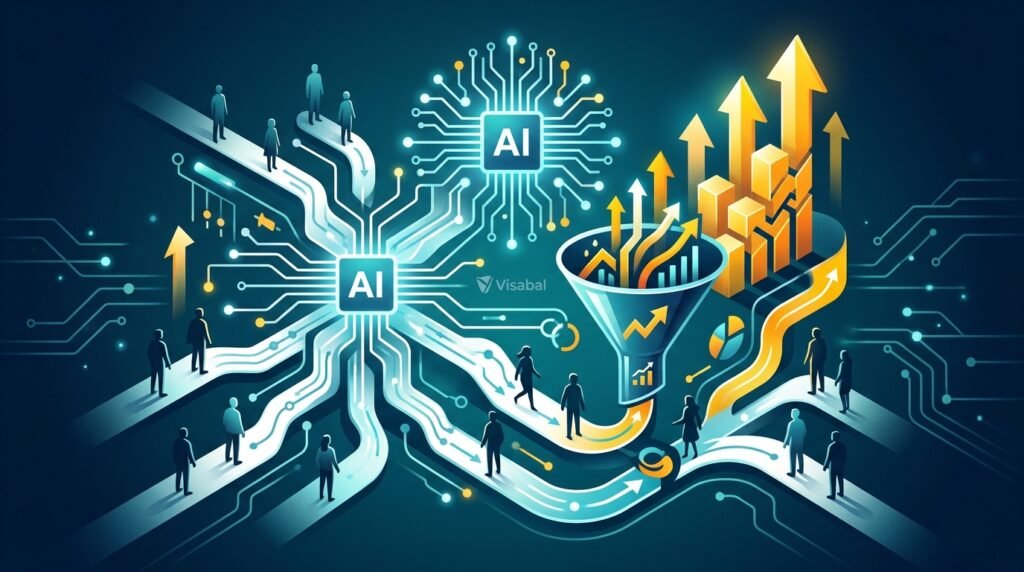
Customer acquisition has become more expensive, more fragmented, and more data-driven. Paid channels are crowded. Buyers expect relevant outreach. Sales teams have limited time. Marketing teams are under pressure to prove revenue impact, not just generate clicks or leads.
That is why an AI customer acquisition strategy matters. Not because AI magically replaces marketing or sales, but because it helps teams make better decisions faster: who to target, what to say, when to engage, which channels to prioritize, and where to invest budget.
A strong AI customer acquisition strategy is not simply adding a chatbot or automating email sequences. It is a structured approach to using data, machine learning, generative AI, and workflow intelligence across the full acquisition journey. The goal is simple: acquire better-fit customers more efficiently and consistently.
What is an AI customer acquisition strategy?
An AI customer acquisition strategy is a plan for using artificial intelligence to identify, attract, engage, qualify, and convert new customers. It combines customer data, predictive models, content personalization, sales intelligence, and performance measurement into one coordinated growth system.
The strategic part is important. AI tools are easy to buy, but results come from knowing where AI should influence decisions. For example, AI can help you:
- Identify the accounts most likely to buy
- Segment prospects based on intent, fit, and behavior
- Personalize landing pages, ads, emails, and sales messages
- Score leads with more nuance than static rules
- Recommend the next best action for sales or marketing
- Analyze lost opportunities and improve future campaigns
- Forecast acquisition performance by channel and segment
In other words, AI helps customer acquisition become less reactive and more predictive.
Why AI changes customer acquisition
Traditional acquisition strategies often rely on broad personas, historical assumptions, and manual campaign analysis. Teams launch campaigns, wait for results, and then adjust. That process still works, but it is slow.
AI allows teams to learn from signals in near real time. It can detect patterns that are difficult for humans to spot, especially across large volumes of behavioral, firmographic, demographic, and engagement data.
For example, two leads might both download the same guide. A basic acquisition system treats them similarly. An AI-assisted system may recognize that one visitor came from a high-intent search query, works at a company matching your ideal customer profile, returned to your pricing page twice, and resembles past closed-won deals. That lead deserves a different acquisition motion.
This is where AI creates leverage. It helps your team stop treating all prospects equally and start allocating attention based on probability, potential value, and readiness.
Start with a sharper ideal customer profile
The foundation of any AI customer acquisition strategy is a clear ideal customer profile, often called an ICP. AI performs best when it has a defined target. If your inputs are vague, your outputs will be noisy.
Begin by analyzing your best customers, not just your biggest ones. Look for patterns such as:
- Industry or niche
- Company size
- Revenue range
- Geography
- Technology stack
- Buying committee structure
- Pain points that triggered purchase
- Sales cycle length
- Retention and expansion potential
- Support burden after purchase
AI can enrich this analysis by clustering customers into meaningful segments and surfacing patterns that may not appear in a spreadsheet. For instance, you might discover that mid-market teams using a specific software category convert faster, adopt more successfully, and renew at higher rates.
That insight should influence targeting, messaging, budget allocation, and sales prioritization.
Build a useful acquisition data layer
AI needs reliable data. Before adding more tools, assess the quality and accessibility of your acquisition data. Common sources include CRM records, website analytics, ad platforms, email engagement, product usage, customer support conversations, call transcripts, and third-party intent data.
A practical data layer should answer questions like:
- Where did this prospect come from?
- What actions have they taken?
- How closely do they match our ICP?
- What content or messaging have they engaged with?
- Which sales conversations or objections have occurred?
- What happened after conversion?
The key is not collecting every possible data point. The key is collecting enough relevant data to improve decisions.
If your team is also looking for a broader operational framework beyond strategy, Visabal has a separate practical guide on building a repeatable customer acquisition system that complements this strategic approach.
Use AI to improve targeting and segmentation
One of the highest-value applications of AI in acquisition is smarter targeting. Instead of relying only on broad audience categories, AI can help you create dynamic segments based on fit, behavior, and intent.
Examples include:
- High-fit accounts showing current buying intent
- Leads similar to recent closed-won customers
- Website visitors who match a profitable customer segment
- Dormant prospects who recently re-engaged
- Accounts with multiple stakeholders researching related topics
These segments allow marketing and sales to coordinate more effectively. Paid campaigns can focus on high-probability audiences. Email campaigns can adapt messaging by segment. Sales teams can prioritize outreach based on likely revenue impact.
The strategic advantage is not just efficiency. Better segmentation also improves the customer experience because prospects receive more relevant communication.
Personalize the acquisition journey with AI
Personalization has moved beyond inserting a first name into an email. AI makes it possible to personalize acquisition journeys based on context.
For example, a prospect from a healthcare company should not necessarily see the same proof points as a SaaS founder or an operations leader in logistics. Their concerns, buying triggers, and objections may be different.
AI can support personalization across:
- Website headlines and calls to action
- Landing page content
- Email sequences
- Ad creative variations
- Sales outreach messages
- Case study recommendations
- Chat experiences
- Demo follow-up content
However, personalization should be useful, not creepy. The best approach is to tailor based on business relevance. Mention the prospect’s industry, likely challenge, or role-specific outcome. Avoid overusing personal data in ways that feel invasive.
Apply predictive lead scoring
Many lead scoring systems are too simplistic. They assign points for actions such as opening an email or visiting a page, but they often miss the bigger picture.
AI-powered lead scoring can evaluate a wider range of signals and compare them against historical outcomes. Instead of asking whether a lead completed one action, it asks how similar that lead is to prospects that became qualified opportunities or paying customers.
A strong predictive score may include:
- ICP fit
- Engagement quality
- Buying intent signals
- Channel source
- Content consumed
- Company attributes
- Stakeholder activity
- Historical conversion patterns
This helps teams avoid two common mistakes: ignoring quiet but high-fit buyers, and over-prioritizing noisy but low-quality leads.
Use generative AI for message testing, not generic content
Generative AI can accelerate acquisition content, but it should not make your messaging bland. The risk is that every company starts sounding the same: faster growth, better results, seamless experience.
Use generative AI to produce variations, analyze objections, adapt messages for segments, and speed up testing. Then apply human judgment to sharpen the offer, voice, and positioning.
Useful prompts might focus on:
- Rewriting a value proposition for a specific industry
- Creating ad variations based on customer pain points
- Summarizing sales call objections into campaign themes
- Turning customer proof into landing page copy
- Comparing messaging angles for different buyer roles
The best AI-assisted messaging still depends on strong inputs: real customer language, clear differentiation, and evidence that supports your claims.
Align marketing and sales around next best actions
AI customer acquisition works best when it connects marketing activity with sales action. If AI identifies a high-intent account but no one follows up, the insight is wasted.
A next-best-action model can recommend what should happen next based on prospect behavior and stage. For example:
- Send a comparison guide
- Invite the prospect to a demo
- Route to a senior sales rep
- Trigger a retargeting campaign
- Share a relevant case study
- Pause outreach because engagement is declining
This creates a more coordinated acquisition motion. Marketing warms the market. Sales engages at the right moment. AI helps determine timing and context.
Measure the right acquisition metrics
An AI customer acquisition strategy should be evaluated by business outcomes, not tool activity. Do not measure success by the number of AI-generated emails or automated recommendations. Measure whether acquisition becomes more efficient and predictable.
Important metrics include:
- Customer acquisition cost
- Cost per qualified opportunity
- Lead-to-opportunity conversion rate
- Opportunity-to-customer conversion rate
- Sales cycle length
- Average contract value
- Pipeline velocity
- Win rate by segment
- Retention rate by acquisition source
- Payback period
The most mature teams connect acquisition data to downstream revenue quality. A channel that produces cheap leads but poor-fit customers may look good early and expensive later. AI should help you optimize for profitable growth, not vanity metrics.
Manage risk, privacy, and trust
AI introduces new responsibilities. Customer acquisition often involves personal or company data, so privacy and compliance must be part of the strategy from the beginning.
Set clear rules for:
- What data AI systems can use
- Who can access AI-generated insights
- How recommendations are reviewed
- What claims can appear in AI-generated content
- How consent and opt-outs are handled
- How bias is monitored in targeting and scoring
Trust also matters externally. Prospects should feel that your communication is relevant and respectful. AI should make acquisition more helpful, not more aggressive.
A practical roadmap for building your AI customer acquisition strategy
If you are starting from scratch, do not try to transform everything at once. Build in phases.
First, clarify your ICP and acquisition goals. Decide which customer segments matter most and what outcomes you want to improve.
Second, audit your data. Identify which sources are reliable, which are incomplete, and which need to be connected.
Third, choose one or two high-impact use cases. Predictive lead scoring, account prioritization, and message personalization are often good starting points.
Fourth, test in a controlled environment. Compare AI-assisted segments or campaigns against your current baseline.
Fifth, operationalize what works. Add workflows, reporting, and ownership so insights lead to action.
Finally, review performance regularly. AI models and buyer behavior change over time. Your strategy should evolve with them.
The bottom line
An AI customer acquisition strategy is not about replacing human judgment. It is about giving your team better intelligence, faster learning loops, and more precise execution.
The companies that benefit most from AI are not the ones that add the most tools. They are the ones that combine clear positioning, clean data, disciplined experimentation, and strong human oversight.
For Visabal, the opportunity is clear: AI can help growth teams move from scattered acquisition tactics to a smarter system that identifies the right buyers, delivers the right message, and improves revenue efficiency over time.
Frequently asked questions
What is an AI customer acquisition strategy?
An AI customer acquisition strategy is a plan for using artificial intelligence to identify, target, engage, qualify, and convert new customers more efficiently. It typically includes data analysis, predictive lead scoring, personalization, segmentation, and performance optimization.
How does AI improve customer acquisition?
AI improves customer acquisition by helping teams identify better-fit prospects, prioritize high-intent leads, personalize outreach, optimize campaigns faster, and connect marketing activity to revenue outcomes.
What data is needed for AI customer acquisition?
Useful data includes CRM records, website behavior, campaign engagement, firmographic data, sales conversations, customer outcomes, product usage, and intent signals. The most important requirement is that the data is accurate, relevant, and connected to business outcomes.
Is AI customer acquisition only for large companies?
No. Smaller teams can use AI for focused use cases such as lead scoring, message personalization, audience research, and campaign analysis. The key is to start with a clear goal rather than adopting AI tools without a strategy.
What is the biggest mistake companies make with AI customer acquisition?
The biggest mistake is treating AI as a standalone tool instead of part of a broader growth strategy. AI works best when it is connected to a clear ICP, quality data, defined workflows, and measurable revenue goals.