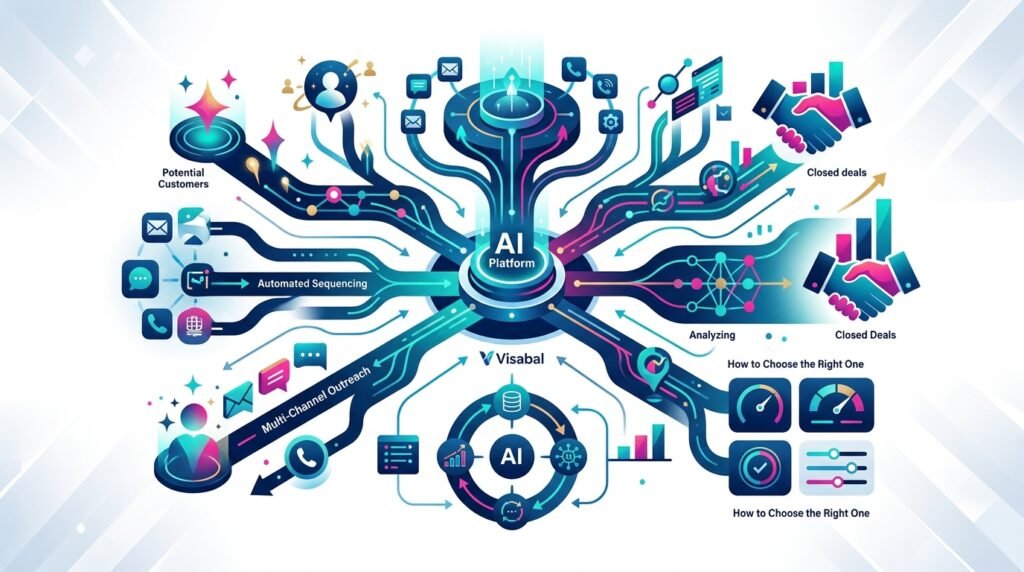
An AI BDR platform helps sales teams automate and improve the work traditionally handled by business development representatives: identifying accounts, researching prospects, writing outreach, following up, qualifying interest, and booking meetings.
But the best AI BDR platforms are not just email automation tools with an AI writing button. They combine data, workflow automation, personalization, lead intelligence, and human oversight so companies can build pipeline more consistently without overwhelming their sales team.
For growing businesses, this matters because outbound sales is getting harder. Buyers receive more messages than ever. Generic sequences are ignored. Manual research takes too long. Reps spend too much time switching between tools instead of having relevant conversations. An AI BDR platform is designed to solve that operational gap.
This guide explains what an AI BDR platform is, how it works, what features to look for, and how to evaluate whether it is the right fit for your sales process.
What Is an AI BDR Platform?
An AI BDR platform is software that uses artificial intelligence to support or automate business development activities across the outbound sales workflow.
A traditional BDR focuses on prospecting, outreach, qualification, and handoff to sales. An AI BDR platform assists with those same activities by using data and automation to:
- Find target accounts and contacts
- Research companies, industries, and decision-makers
- Generate personalized outreach messages
- Prioritize leads based on fit or intent signals
- Manage follow-up sequences
- Surface replies that need human attention
- Help qualify opportunities before sales engagement
The goal is not simply to replace human relationship-building. The goal is to remove repetitive manual work so sales teams can focus on judgment, strategy, and conversations that move deals forward.
Why Companies Are Looking for AI BDR Platforms
Many teams adopt AI BDR technology because their outbound process has become difficult to scale manually.
Common problems include:
- Reps spending hours researching accounts before writing a single message
- Low reply rates from generic outbound sequences
- Inconsistent follow-up due to workload or poor process discipline
- Leads sitting untouched because no one has time to prioritize them
- Sales and marketing teams using disconnected tools and data
- New reps taking too long to ramp into productive prospecting
An AI BDR platform helps create a repeatable system. It gives teams a way to combine targeting, personalization, outreach, and qualification in one structured workflow.
This is different from a broader growth system. If you are exploring company-wide AI adoption across acquisition, operations, and scale, Visabal also covers that broader perspective in its guide to an AI business growth platform for scaling smarter. This article focuses specifically on the BDR and outbound sales use case.
How an AI BDR Platform Works
Most AI BDR platforms support several connected stages of outbound sales.
1. Ideal Customer Profile and Account Targeting
The process starts with defining the types of companies and buyers you want to reach. This usually includes firmographic, geographic, industry, revenue, employee count, technology usage, or job-title criteria.
A strong AI BDR platform helps translate your ideal customer profile into prospecting logic. Instead of relying only on static lists, it can identify better-fit accounts and help prioritize where outreach should begin.
For example, a company selling financial operations software may want to target CFOs and controllers at mid-market companies hiring finance roles, expanding internationally, or using outdated accounting systems. The AI BDR platform can use those criteria to build a more relevant prospecting queue.
2. Prospect and Company Research
Manual research is one of the biggest time drains in outbound sales. A good AI BDR platform can summarize useful context about a company, prospect, recent event, or role.
This may include:
- Company description and market position
- Recent funding, hiring, product launches, or leadership changes
- Prospect responsibilities based on title and department
- Possible pain points tied to the business model
- Relevant talking points for outreach
The value is speed and consistency. Instead of each rep starting from a blank page, the platform creates a usable research brief that can inform personalized outreach.
3. AI-Powered Message Creation
One of the most visible features of an AI BDR platform is message generation. The platform can draft cold emails, LinkedIn messages, follow-ups, call openers, and objection-handling responses.
However, quality matters. Good AI-generated outbound should be specific, concise, and relevant. It should not sound like a mass-produced template.
The best platforms use prospect context, company signals, offer positioning, and campaign goals to produce messages that feel purposeful. Human review is still important, especially for strategic accounts, but AI can dramatically reduce the time required to create a strong first draft.
4. Sequencing and Follow-Up Automation
Outbound usually requires multiple touches. Prospects rarely respond to the first message, even when the offer is relevant.
An AI BDR platform can manage structured follow-up across channels, such as email and LinkedIn. It can also help adjust messaging based on engagement, role, or previous responses.
This makes follow-up more reliable. Instead of depending on every rep to remember every task, the platform keeps the process moving while flagging moments where human attention is needed.
5. Reply Handling and Qualification
Some platforms can classify replies and recommend next steps. For example, they may identify whether a response is positive, negative, out-of-office, referral-based, objection-based, or requesting more information.
This is useful because not every reply should be treated the same way. A pricing objection requires a different response than a request to contact another stakeholder. AI can help sort and prioritize responses so salespeople spend time where it matters most.
6. CRM Sync and Sales Handoff
For an AI BDR platform to be useful, it must fit into the sales team’s existing workflow. That means syncing with CRM systems, updating contact records, logging activity, and triggering handoffs when a lead is ready for sales engagement.
Without this connection, AI prospecting creates more admin work. With it, the platform becomes part of the revenue operating system.
Key Features to Look For in an AI BDR Platform
Not all tools marketed as AI BDR platforms are equal. When evaluating options, focus on capabilities that improve the actual outbound process.
Accurate Targeting and Data Quality
AI is only as good as the data and criteria behind it. Look for a platform that helps you define specific audiences and work with reliable prospect information. Poor data leads to wasted outreach, low deliverability, and weak personalization.
Personalization at Scale
The platform should do more than insert a first name and company name. It should generate messaging based on real business context, prospect roles, account signals, and your value proposition.
Workflow Control
Automation should not mean losing control. Your team should be able to review messaging, approve campaigns, set rules, exclude accounts, adjust tone, and define when a human should step in.
Deliverability Awareness
Outbound performance depends on email reputation and deliverability. A serious AI BDR platform should support responsible sending practices, list hygiene, domain protection, and campaign pacing.
CRM and Tool Integration
If your AI BDR platform does not connect with your CRM, it may create operational friction. Look for integrations that keep records, tasks, activity logs, and opportunity handoffs aligned.
Analytics and Learning
The platform should show what is working. Useful metrics include open rates, reply rates, positive reply rates, meetings booked, conversion by segment, sequence performance, and messaging effectiveness.
What an AI BDR Platform Should Not Do
AI can improve outbound sales, but it should not encourage bad habits at higher volume.
An AI BDR platform should not be used to blast irrelevant messages to thousands of contacts. That approach damages brand trust, hurts deliverability, and produces poor sales outcomes.
It should also not remove human judgment from strategic selling. Complex deals still require thoughtful account planning, discovery, negotiation, and relationship-building.
The best use of AI in BDR work is targeted assistance: better research, sharper messaging, faster execution, stronger prioritization, and more consistent follow-up.
How to Evaluate Whether Your Team Needs One
Before investing in an AI BDR platform, ask these practical questions:
- Do we have a clearly defined ideal customer profile?
- Are our outbound messages currently too generic?
- Are reps spending too much time on manual research?
- Do leads or target accounts fall through the cracks?
- Is follow-up inconsistent across the team?
- Do we know which audiences and messages convert best?
- Can our CRM support clean handoff and reporting?
If the answer to several of these questions is yes, an AI BDR platform may create immediate operational value.
If your targeting is unclear or your offer is not well-defined, start there first. AI can accelerate a good sales process, but it cannot fix a confused market position on its own.
Implementation Tips for Better Results
To get value from an AI BDR platform, treat implementation as a revenue process improvement project, not just a software rollout.
Start with one specific segment. Choose a defined audience, such as SaaS operations leaders at companies with 100 to 500 employees, rather than trying to reach every possible buyer at once.
Create clear messaging inputs. The platform needs to understand your offer, pain points, proof points, competitive differentiation, and desired call to action.
Set approval rules. Decide which messages can go out automatically and which require manual review. For high-value accounts, human review is usually worth the extra time.
Measure quality, not only quantity. Meetings booked are important, but positive reply rate, opportunity fit, and pipeline quality matter more than raw send volume.
Refine continuously. Use campaign data to improve targeting, messaging, timing, and qualification criteria.
The Role of Visabal
Visabal helps businesses use AI in practical, revenue-focused ways. For teams exploring an AI BDR platform, the priority is not adding another tool for the sake of automation. The priority is building a smarter outbound workflow that supports real pipeline generation.
That means connecting strategy, data, messaging, and execution. An AI BDR platform should help your team spend less time on repetitive tasks and more time engaging the right buyers with the right message.
Final Thoughts
An AI BDR platform can be a powerful advantage for sales teams that need to scale outbound prospecting without sacrificing relevance. It can help identify better accounts, personalize outreach, automate follow-up, and qualify replies more efficiently.
But success depends on how the platform is used. The strongest results come from clear targeting, thoughtful messaging, human oversight, and continuous optimization.
For companies serious about pipeline growth, an AI BDR platform is not just a productivity tool. It is a way to make business development more focused, consistent, and scalable.
Frequently asked questions
What is an AI BDR platform?
An AI BDR platform is software that uses artificial intelligence to support business development work such as prospect research, lead prioritization, personalized outreach, follow-up automation, reply handling, and meeting qualification.
Does an AI BDR platform replace sales reps?
No. A strong AI BDR platform reduces repetitive manual work, but human judgment is still essential for strategy, relationship-building, discovery, negotiation, and managing high-value opportunities.
What features should I look for in an AI BDR platform?
Important features include accurate targeting, reliable data, AI-assisted personalization, sequence automation, deliverability controls, CRM integration, reply classification, workflow approvals, and analytics that show pipeline impact.
How is an AI BDR platform different from regular sales automation?
Traditional sales automation usually focuses on sending sequences and tracking activity. An AI BDR platform adds intelligence around research, prioritization, message generation, personalization, reply handling, and optimization.
When should a company use an AI BDR platform?
A company should consider an AI BDR platform when outbound prospecting is time-consuming, follow-up is inconsistent, messaging is too generic, reps are overloaded with research, or the team needs a more scalable way to generate qualified pipeline.